
 English
 Chinese
 Dutch
 Arabic
 Spanish
 Portuguese
 Russian
 French
 Italian
 German
 Japanese
In the Bible, fish mostly mean three things: the people God gathers, the food he gives, and the meals the risen Jesus shared. Jesus called two fishermen to be “fishers of men” (Matthew 4:19), fed thousands with five loaves and two fish, and after rising from the dead ate “a piece of a broiled fish” (Luke 24:42).
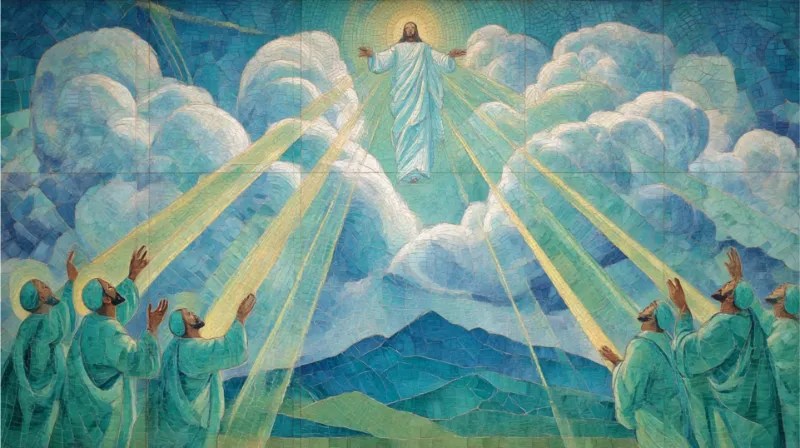
All three meet on one morning by the Sea of Tiberias. Seven disciples had fished all night and caught nothing. At a word from a man on the shore their net filled, and when they came to land they found a fire of coals with fish laid on it. “Come and dine,” Jesus said. The fishermen he had sent to gather people were fed first, from his own hands.
The fish swims through other passages too. Jesus made Jonah’s great fish a sign of his own three days in the grave, John counts 153 fish in that last great catch, and the law of Moses let Israel eat only fish with fins and scales. The fish sign Christians draw today is not in the Bible. The early Church read the Greek word for fish, ichthys, as the initials of Jesus Christ, God’s Son, Saviour, and made it a sign for Christ himself.
Where do fish appear in the Bible?
Fish appear from the creation in Genesis to Paul’s First Letter to the Corinthians, which counts the flesh “of fishes” as one kind beside the flesh of men, beasts and birds (1 Corinthians 15:39). The Bible never names a particular kind of fish. Hebrew uses general words for them, such as dag, and Jonah’s is simply “a great fish” (Jonah 1:17).
| Passage | What happens | What it shows |
|---|---|---|
| Genesis 1:20–21 | God fills the waters with living creatures | Life God made |
| Exodus 7:21 | The fish in Egypt’s river die | Life lost under judgment |
| Leviticus 11:9–12 | Fish with fins and scales are clean | Israel’s food law |
| Jonah 1:17; 2:10 | A great fish swallows Jonah and spits him out | God’s rescue; for Jesus, his three days in the grave |
| Ezekiel 47:9–10 | A river heals the waters and fish fill them | Life wherever the temple’s river flows |
| Tobit 6; 11 | A fish’s gall cures Tobit’s blindness | Healing |
| Matthew 4:19; Luke 5:10 | Jesus calls fishermen | People to be gathered |
| Matthew 13:47–50 | A net gathers fish of every kind | Everyone, sorted at the end of the world |
| Matthew 14:17–21 | Five loaves and two fish feed thousands | God’s provision |
| Luke 24:41–43 | The risen Jesus eats broiled fish | A real body, not a ghost |
| John 21:1–14 | 153 fish, then breakfast on the shore | The disciples’ mission, and Jesus feeding them |
Does dreaming of fish mean anything in the Bible?
The Bible gives no meaning for dreams about fish, and none of the dreams it records has a fish in it. Scripture tells of many dreams but offers no key to dream symbols. When a dream is explained, the meaning comes from God for that one dream: Joseph asked two prisoners, “Do not interpretations belong to God?” (Genesis 40:8), and Daniel told a king, “there is a God in heaven that revealeth secrets” (Daniel 2:28).
The nearest thing is a vision, not a dream. Ezekiel saw a river flowing from under the threshold of the temple until “there shall be a very great multitude of fish, because these waters shall come thither: for they shall be healed; and every thing shall live whither the river cometh” (Ezekiel 47:9). It is a promise of life wherever that river reaches.

Why did Jesus call his disciples fishers of men?
His first disciples were fishermen, and he called them to new work: catching people. Matthew sets the scene by the Sea of Galilee: Jesus “saw two brethren, Simon called Peter, and Andrew his brother, casting a net into the sea: for they were fishers,” and said to them, “Follow me, and I will make you fishers of men” (Matthew 4:18–19). James and John were in their father’s boat “mending their nets” when he called them too (Matthew 4:21).
In Luke’s account a great catch comes before the call. Simon had “toiled all the night” and taken nothing, but at Jesus’ word he let the net down again, and “they inclosed a great multitude of fishes: and their net brake.” Then Jesus said to him, “Fear not; from henceforth thou shalt catch men” (Luke 5:5–10).
The fish in this picture are people. The prophets had used the image before, for people caught and judged. Habakkuk complained that God had made people “as the fishes of the sea,” for others to “catch them in their net” (Habakkuk 1:14–15), and through Jeremiah God warned, “I will send for many fishers, saith the Lord, and they shall fish them,” a search no one could hide from (Jeremiah 16:16–17). Jesus sent his fishermen out to gather people into the kingdom.
His parable of the net takes the picture to the end of the world. The kingdom of heaven is “like unto a net, that was cast into the sea, and gathered of every kind.” On the shore the good fish are kept and the bad thrown away: “So shall it be at the end of the world: the angels shall come forth, and sever the wicked from among the just” (Matthew 13:47–49). The net takes in every kind, and the sorting is left to the angels.
Early Christian teachers kept the image. Cyril of Jerusalem told people preparing for baptism, “You have come within the Church’s nets: be taken alive, flee not: for Jesus is angling for you, not in order to kill, but by killing to make alive.”

How many loaves and fish fed the crowds?
Five loaves and two fish fed about five thousand men, and seven loaves and “a few little fishes” fed four thousand (Matthew 15:34). All four Gospels tell the first feeding; Matthew and Mark tell both.
| The five thousand | The four thousand | |
|---|---|---|
| Food | Five loaves, two fish | Seven loaves, a few small fish |
| People fed | About 5,000 men, besides women and children | 4,000 men, besides women and children |
| Left over | Twelve baskets | Seven baskets |
| Gospels | Matthew 14, Mark 6, Luke 9, John 6 | Matthew 15, Mark 8 |
John’s account shows how little there was. Andrew points to a boy: “There is a lad here, which hath five barley loaves, and two small fishes: but what are they among so many?” (John 6:8–9). When everyone had eaten, Jesus told the disciples, “Gather up the fragments that remain, that nothing be lost,” and they filled twelve baskets (John 6:12–13).
In these meals fish are plain food, and God gives more than enough of it. Jesus used the same food to describe the Father: “Or if he ask a fish, will he give him a serpent? If ye then, being evil, know how to give good gifts unto your children, how much more shall your Father which is in heaven give good things to them that ask him?” (Matthew 7:10–11). Even the tribute Peter paid for himself and Jesus came out of a fish, which had “a piece of money” in its mouth (Matthew 17:24–27).
Matthew tells the feeding with the words he later uses at the Last Supper. At the lakeside Jesus “blessed, and brake, and gave the loaves to his disciples” (Matthew 14:19); at the table he “took bread, and blessed it, and brake it, and gave it to the disciples” (Matthew 26:26). Later in John’s chapter on the feeding Jesus says, “I am the bread of life” (John 6:35). The Catholic Catechism draws the link: “The miracles of the multiplication of the loaves, when the Lord says the blessing, breaks and distributes the loaves through his disciples to feed the multitude, prefigure the superabundance of this unique bread of his Eucharist” (Catechism 1335).
Why did the risen Jesus eat fish?
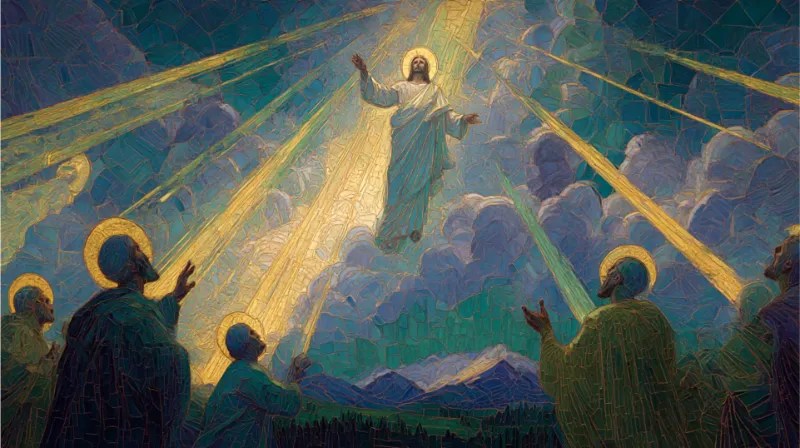
To show his disciples that he had risen in a real body. In Luke they “supposed that they had seen a spirit.” Jesus showed them his hands and feet, saying, “a spirit hath not flesh and bones, as ye see me have,” and while they still could not believe it for joy, he asked, “Have ye here any meat?” Then: “they gave him a piece of a broiled fish, and of an honeycomb. And he took it, and did eat before them” (Luke 24:37–43). The meal answered their fear that he was a ghost.
John tells of a second meal, at the Sea of Tiberias. Seven disciples went fishing, “and that night they caught nothing.” At dawn a man on the shore told them, “Cast the net on the right side of the ship, and ye shall find,” and they could not haul it in “for the multitude of fishes.” The disciple whom Jesus loved said to Peter, “It is the Lord” (John 21:2–7).
On land they found “a fire of coals there, and fish laid thereon, and bread.” Jesus said, “Come and dine,” and he “taketh bread, and giveth them, and fish likewise” (John 21:9–13). The words recall the feeding of the five thousand, when he handed out the loaves “and likewise of the fishes as much as they would” (John 6:11). When they had eaten, he asked Peter three times whether he loved him, and told him, “Feed my sheep” (John 21:15–17).

What do the 153 fish in John 21 mean?
John gives the count and no explanation: “Simon Peter went up, and drew the net to land full of great fishes, an hundred and fifty and three: and for all there were so many, yet was not the net broken” (John 21:11). Christians have looked for a meaning ever since, and two early readings come from Jerome and Augustine.
Jerome connected the catch with Ezekiel’s vision of fishermen spreading their nets beside a healed sea, where the fish would be “according to their kinds, as the fish of the great sea, exceeding many” (Ezekiel 47:10). In his commentary on that chapter (summarised from his Latin), he wrote that writers on the natures of animals, among them the poet Oppian of Cilicia, count 153 kinds of fish. The apostles caught every kind and left none, he said, as the noble and the lowly, rich and poor, and every kind of person are drawn out of the sea of this world to be saved. On his reading the number stands for every kind of person.
Augustine reached the number another way in his tractates on John’s Gospel. Seventeen, he said, joins ten, the number of the law’s commandments, to seven, a number of the Holy Spirit; and adding every number from 1 to 17 gives 153. “All therefore who are sharers in such grace are symbolized by this number,” he wrote, and “it is not on that account merely a hundred and fifty-three saints that are meant,” but thousands. He also set the two great catches side by side. In Luke the net broke and the boats began to sink, and Augustine read that catch as the Church in this world, with good and bad mixed together. In John the net held, and he read it as the Church at the end of the world, holding the good only.
The arithmetic is right: 1 + 2 + 3 and so on up to 17 makes 153. Jerome and Augustine counted differently, but both read the fish in the net as people, as Jesus had when he called fishermen to catch men.

Was Jonah swallowed by a whale or a fish?
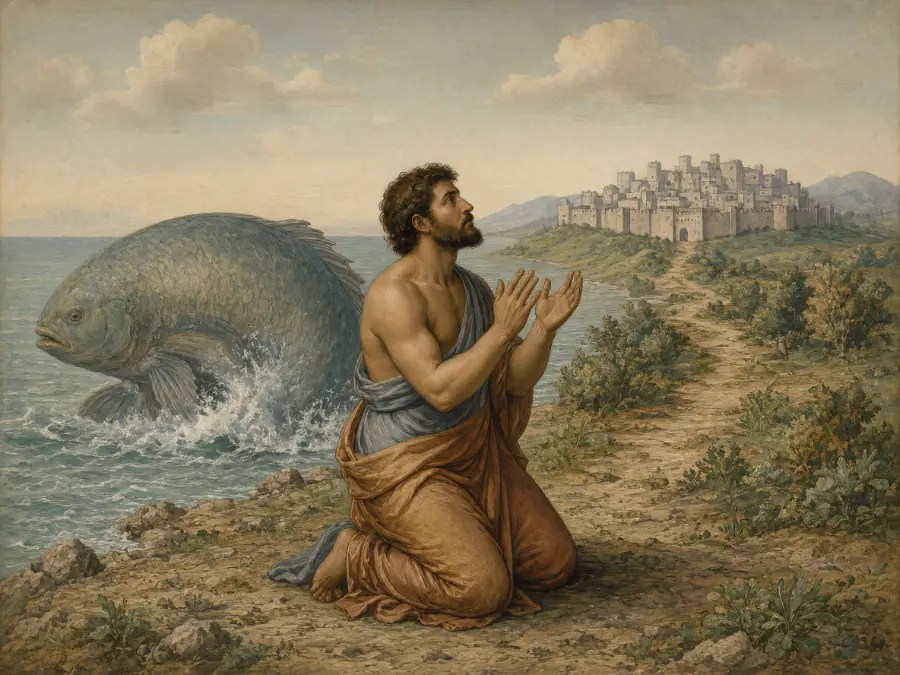
The book of Jonah calls it a fish and never says what kind: “Now the Lord had prepared a great fish to swallow up Jonah. And Jonah was in the belly of the fish three days and three nights” (Jonah 1:17). After Jonah prayed, “the Lord spake unto the fish, and it vomited out Jonah upon the dry land” (Jonah 2:10). French and German Bibles such as the Segond and the Luther Bible number these two verses 2:1 and 2:11. The King James Version says “whale” when Jesus retells the story in Matthew 12:40, but the Greek word there, kētos, means “any sea-monster or huge fish” in the Greek lexicon of Liddell and Scott.
In Jonah the fish is God’s instrument: the Lord prepares it, and it obeys his word. Jesus made it a sign of his own death and rising: “For as Jonas was three days and three nights in the whale’s belly; so shall the Son of man be three days and three nights in the heart of the earth” (Matthew 12:40). He went on to say that the men of Nineveh, who repented at Jonah’s preaching, would condemn his own generation (Matthew 12:41), the other half of the sign of Jonah.

Which fish could Israel eat?
Fish with both fins and scales. The law of Moses says, “These shall ye eat of all that are in the waters: whatsoever hath fins and scales in the waters, in the seas, and in the rivers, them shall ye eat,” and “Whatsoever hath no fins nor scales in the waters, that shall be an abomination unto you” (Leviticus 11:9, 12). Deuteronomy gives the same rule: whatever lacks them “is unclean unto you” (Deuteronomy 14:10).
Jewish law built on the rule. The Jewish Encyclopedia (1901–1906) recorded that the authorities of the Talmud “have also made some additions to the regulations in the Scriptures.” The Mishnah (Niddah 6:9) “declares that all fishes with scales have, doubtless, fins also,” so the scales settled the question, while “a fish with fins may be without scales and thus be unclean.” The shape of the spine, head and bladder gave further signs, and eels were counted unclean.
Christians differ over whether the rule binds them. The Catholic Catechism teaches that “Jesus perfects the dietary law, so important in Jewish daily life,” and quotes Mark’s comment on his teaching, “Thus he declared all foods clean” (Catechism 582). In Acts, Peter hears in a vision, “What God hath cleansed, that call not thou common” (Acts 10:15), and he applies it to people: “God hath shewed me that I should not call any man common or unclean” (Acts 10:28). Seventh-day Adventists ask their members to “abstain from the unclean foods identified in the Scriptures” (Fundamental Belief 22). The wider question is set out in can Christians eat pork.

Why do Catholics eat fish on Friday?
The Bible gives no rule about fish on Fridays. The Catholic practice rests on the Church’s law of penance. The 1983 Code of Canon Law asks for “Abstinence from meat, or from some other food as determined by the Episcopal Conference” on all Fridays (canon 1251), and lets each conference of bishops “substitute other forms of penance” (canon 1253). In the United States the bishops require it on the Fridays of Lent: “Fridays during Lent are obligatory days of abstinence.” Fish is not counted as meat. In the US bishops’ words, “Fish are a different category of animal.”
How did a fish heal Tobit’s eyes?
The Book of Tobit is part of the Old Testament for Catholic and Orthodox Christians. Protestants place it among the Apocrypha; the Church of England’s Thirty-nine Articles, for example, list “The Book of Tobias” among the books the Church “doth read for example of life and instruction of manners; but yet doth it not apply them to establish any doctrine” (Article VI).
In the story, the young Tobias, travelling with the angel Raphael, washes his feet in the river Tigris, “and behold a monstrous fish came up to devour him” (Tobit 6:2, Douay-Rheims). The angel tells him to pull it out and keep “his heart, and his gall, and his liver,” because “the gall is good for anointing the eyes, in which there is a white speck, and they shall be cured” (Tobit 6:5–9). The Douay-Rheims is translated from the Latin Vulgate; Bibles translated from the Greek, such as the New American Bible, tell the scene at 6:3 in different words, with a large fish that leaps from the water and tries to swallow the young man’s foot.
Tobias brings the gall home to his blind father. “Then Tobias taking of the gall of the fish, anointed his father’s eyes,” and when the white film came away, “immediately he recovered his sight” (Tobit 11:13–15). In this book the fish that came to devour becomes the means of God’s healing.
Again and again the Bible’s fish come as gifts: bread and fish passed through a hungry crowd, a coin for the temple tax, a cure for a blind father’s eyes. On the shore of Tiberias they were already cooking when seven fishermen came in from a night of catching nothing, and the risen Lord said to them what he says to us: “Come and dine.”



Leave a Reply